
The End of Static Badges: How TrustEmblem Redefines Digital Credibility with Continuous TaaS

In today’s hyper-connected economy, digital trust is both paramount and notoriously volatile. For years, businesses, content creators, and decentralized platforms relied on static trust seals, PNG certificates, and verification icons to prove authenticity. However, in an era dominated by advanced phishing attacks, brand cloning, and rapid domain spoofing, these static markers are no longer sufficient. They can easily be screenshotted, forged, or left unupdated long after credentials expire.
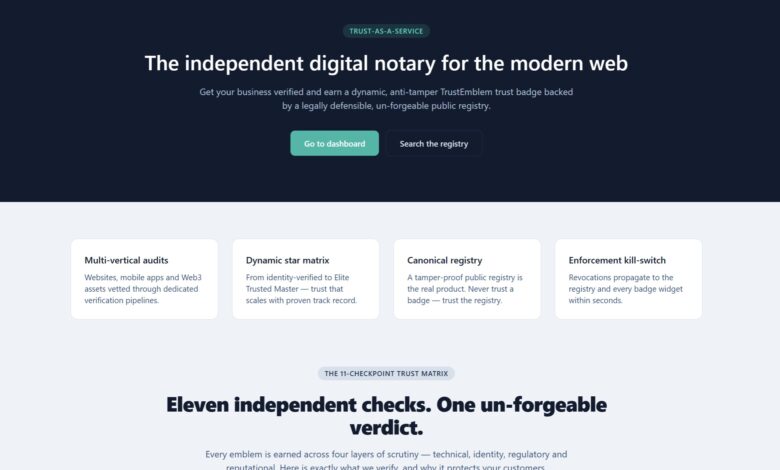
Enter TrustEmblem —a pioneering platform introducing Continuous Trust-as-a-Service (TaaS). By shifting the paradigm from static proof to real-time, automated verification, TrustEmblem bridges the credibility gap across Web2, Web3, social media, and enterprise software ecosystems.
The Flaw of Static Verification in a Dynamic Web
Traditional trust badges give a false sense of security. A JPEG seal displayed on an e-commerce storefront or an static “verified” badge on a consultant’s website only proves that an image was uploaded—not that the business is actively compliant, legitimate, or secure. Cybercriminals regularly copy these images onto fraudulent websites to deceive consumers.


To combat sophisticated impersonation scams, modern digital operations require a shift toward live, audited verification. To understand how automated frameworks compare to traditional setups, organizations can consult TrustEmblem’s approach to building trust , which replaces static badges with an interconnected, continuous monitoring pipeline.
How the Active Trust Lifecycle Works
Rather than issuing a passive seal, TrustEmblem operates an active infrastructure that continuously audits registered assets 24 hours a day, 7 days a week. The framework centers on three core operational pillars:
- Automated 24/7 Auditing: Background monitoring engines continuously check domain configurations, SSL certificates, social media linkages, and Web3 smart contract parameters to ensure active compliance.
- Instant Incident Detection: When an SSL certificate lapses, a critical link breaks, a social handle changes unexpectedly, or a security vulnerability is identified, the system immediately flags the occurrence as an “Incident.”
- Real-Time Live Updates: Operating via high-speed WebSockets, any status change streams directly to the dynamic trust emblem embedded on the user’s platform and updates the authoritative registry entry instantly.
Property and consumer protection are embedded into this model through fair-play protocols; if an issue arises, assets enter an investigation phase managed via the
- to ensure full due process before public status adjustments occur.
Target Use Cases: Securing Ecosystems Across Industries
TrustEmblem’s continuous verification architecture serves a wide spectrum of modern digital operators:
1. Telegram Channels, Content Creators & Influencers
Impersonation of high-profile Telegram channels, VIP investment groups, and YouTube personalities is a widespread challenge. Creators can anchor their public profiles to an authoritative verification page (e.g., verify.trustemblem.com/{business}), providing community members with an instantly verifiable, unforgeable proof of ownership.
2. E-Commerce & SaaS Enterprises
For online retailers and cloud platforms, replacing static badges with dynamic trust emblems ensures customers that payment pathways, domain registrations, and data compliance policies are continuously verified in real time.
3. Web3, NFT & Blockchain Projects
Smart contract security and contract address spoofing are persistent vulnerabilities in decentralized finance. TrustEmblem monitors smart contract audit statuses on-chain, dynamically alerting communities if contract parameters are compromised or modified.
4. Licensed Professionals & Academic Institutions
From accredited universities issuing digital degrees to licensed legal and medical professionals, continuous cross-checking against official registries guarantees that credentials remain active and recognized.
Transparency, Risk Management, and Regulatory Alignment
A resilient credibility ecosystem requires strict guardrails and clear operational disclosures. To protect both buyers and service providers, TrustEmblem maintains transparent fee structures accessible on their Fee Schedule page , ensuring complete clarity regarding service tiers and enterprise audit costs.
Furthermore, because digital risk models vary greatly across sectors—particularly in Web3 and financial services—users and businesses can review the official Risk Disclaimer guidelines to understand how risk scoring and incident tracking are calculated.
“Never trust a static badge—trust the live registry.”
Conclusion: Building the Future of Digital Credibility
As online interactions become increasingly automated and decentralized, static trust indicators are fading into obsolescence. TrustEmblem’s Continuous Trust-as-a-Service model sets a new standard for modern digital credibility, delivering dynamic, unforgeable, and 24/7 audited markers of real-world authority. By connecting audiences directly to live verification registries, TrustEmblem ensures that online trust is earned, maintained, and verified every single second.
Verify Your Digital Identity Today
Protect your brand, community, and customers with real-time continuous trust monitoring.